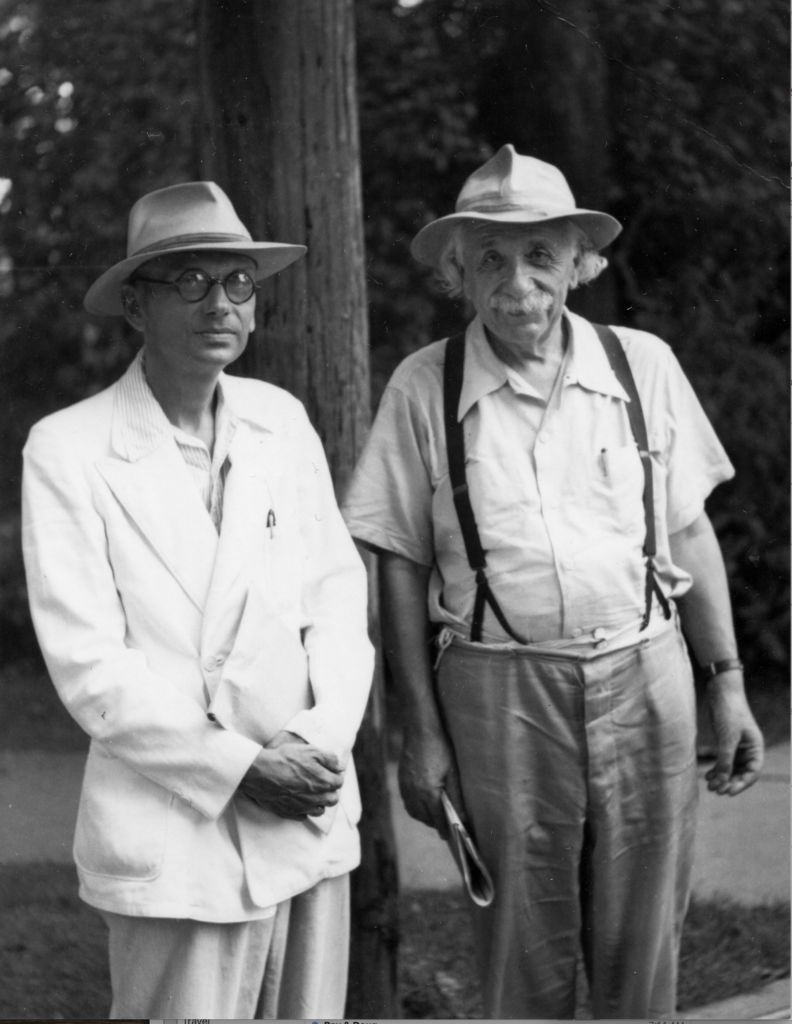
Almost all of the brilliant mathematicians and physicists were introverts who were reluctant to share their innermost feelings with others. Among colleagues they would share some camaraderie, but the competition for academic recognition and top-dog status was generally fierce. As a person, Kurt Gödel was as enigmatic as his arcane theorems. While mathematicians populate the full spectrum from introvert to extravert, Gödel defined a new category at the introvert end of the scale. From early in his life, people described him as a loner. Classmate Harry Klepetar wrote, “Gödel kept more or less to himself and devoted most of his time to his studies.” His stolid personality was manifest in his reluctance to engage in debate when his opinions or ideas were challenged. A growing sense of self-doubt and paranoia began to emerge throughout his middle age and he had frequent visits to the sanitarium for the treatment of depression.
Kurt Gödel’s wife Adele is generally described by biographers as practical, down-to-earth, and socially skilled, in contrast to Gödel’s extreme intellectualism and social awkwardness. Though not formally educated, she is said to have been nurturing and protective, particularly in dealing with everyday matters and in buffering Gödel from stresses he could not manage. In Logical Dilemmas: The Life and Work of Kurt Gödel, John W. Dawson Jr. observes (p. 65), “Adele became, for Gödel, both anchor and shield. She dealt with the outside world, leaving him free to retreat into the realm of pure thought.” On page 300, Dawson states, “Einstein once remarked of Adele that she was a wonderful wife who shielded Gödel as much as possible from the world.”
The mild paranoia evident in Gödel’s earlier years gradually manifested as a fear that he was being poisoned. Adele, ever loyal, became his food taster, eating a portion of his meal to assure him that his meal was not toxic. When Adele was hospitalized in 1977, Gödel refused to eat and on January 14, 1978 he died of starvation and malnutrition in Princeton, New Jersey. The cause of death was reported as “a personality disorder leading to self-starvation. He weighed only 65 pounds.
Just as Adele served as Gödel’s shield from the outside world, Einstein’s second wife, Else served a similar function for Albert. She filtered the requests from people who wished to meet with Einstein, allowing only a chosen few to interrupt his work. When reporters asked her whether she understood Einstein’s theories, she responded, “No, but I understand Albert.” By contrast, Einstein’s first wife Mileva, was a theoretical physicist who had shared intellectual ideas with her husband while they were students. Einstein resented her intrusion on his work, and after a series of vitriolic arguments over a span of several years, they divorced. Einstein was emotionally distant from people and needed a nurturer more than an intellectual equal.
However, not all brilliant scientists were emotionally distant. The relationship between Richard Feynman and Arline Greenbaum is a true-life love story. They were childhood sweethearts during their teenage years at Far Rockaway High School in Queens, New York. They continued to correspond when Feynman attended MIT, pursuing an undergraduate degree in physics. In 1941, when Feynman was 23 years of age and Arline 22, they became engaged. At that time, Richard was at Princeton writing his Ph.D. dissertation titled, The Principle of Least Action in Quantum Mechanics.
A few months after their engagement, Arline was diagnosed with tuberculosis, which at that time was regarded as a terminal illness. The doctors advised Feynman not to marry Arline, because they felt that her death was imminent. Disregarding the doctors’ advice, Richard married Arline on June 29, 1942 in a small civil ceremony.
On June 16, 1945, just a few days short of their third anniversary, Arline died in the hospital as Feynman, holding her hand and making playful jokes, attempted to comfort her in her final moments. Richard was devastated–the love of his life had perished, and he plunged into a period of profound grief.
Still suffering deep sadness more than a year after her death, Feynman decided in October 1946, to write an uplifting greeting to his departed lover. This secret letter that was discovered in Feynman’s personal papers after his death in 1988, opened with:
I adore you, sweetheart. I know how much you like to hear that — but I don’t just write it because you like it — I write it because it makes me warm all over inside to write it to you.
The letter ends with his characteristic ironic humor:
Please excuse my not mailing this — but I don’t know your new address.
In many ways, Feynman’s letter to his wife provides a vivid contrast with the typical stereotype of brilliant mathematicians and physicists. Brilliant intellectuals like Isaac Newton, Nikola Tesla, Albert Einstein, Kurt Gödel, and John Nash were all introverts who experienced difficulty with personal relationships. Richard Feynman was the exception who was able to balance his remarkable talent with strong empathy, a capacity to love, and an intensity of emotion. But even Feynman did not seek an intellectual equal in a spouse; he had that part covered, and merely needed someone to love and share his life. Each of us has an emotional and a rational side, and those who are heavily loaded on the rational component seek someone more gifted on the emotional component to achieve balance and harmony.