A substantial level of subject knowledge is almost always necessary to make breakthroughs in a particular academic pursuit. However, there is a danger in being immersed in the current theories and ideas of a scientific community, that resemble the problems the emerge in groupthink. Discussions in a groupthink context are found to “homogenize” the ideas of the renegades and innovative thinkers in a group. Throughout the history of mathematics and science, we have seen that some of the most ingenious and original discoveries have come from the renegades who lived “outside” the standard environment.
One morning in 1913, Godfrey Hardy, a distinguished number theorist at Cambridge University, received a large untidy envelope adorned with Indian stamps. Inside the envelope were pages of rough notes containing weird and unfamiliar looking mathematical theorems and identities–products of the intuition of a brilliant, but unschooled mind.
The originator of the letter was a poor 26-year-old clerk from Madras, India, named Srinivasa Ramanujan. So impressive was the manuscript, that Hardy made provision for Ramanujan to visit Cambridge to collaborate with him in mathematical research. In the seven years that followed, Ramanujan and Hardy established one of the most successful collaborations in the history of mathematics. In a tragic turn of events, Ramanujan contracted tuberculosis while at the peak of his creativity and died at age 33. When a colleague mused, “Imagine what he would have achieved if he had received formal schooling,” Hardy responded, “He would have been less “Ramanujan.”–i.e., less innovative.
Einstein, the icon for genius, is famous for his discoveries that time is not absolute and that gravity is more appropriately expressed as a change of geometry in the vicinity of mass rather than a force between two masses at a distance. Both of these discoveries were a significant departure from current thinking at the time, and it took a maverick–a young patent clerk who had just earned his Ph.D.–to change the prevailing paradigm.
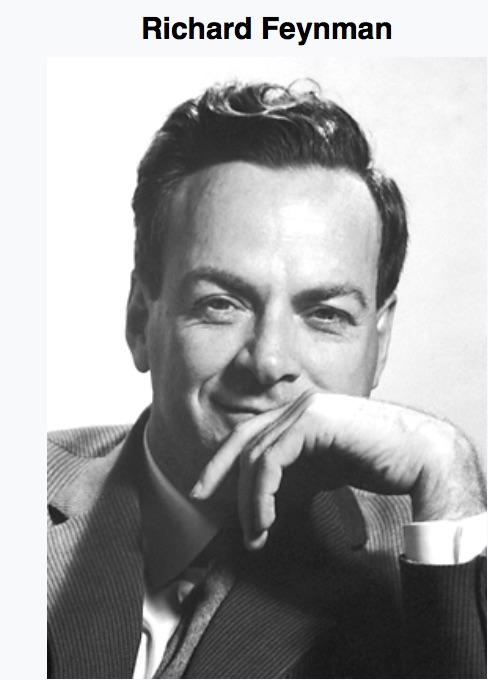
Recognizing that immersion in the current beliefs of a particular academic community can suppress uniquely creative thinking, Richard Feynman behaved as a renegade and constantly avoided absorbing too much of the standard dogma in his field. In his attempt to keep a fresh, independent view, he often avoided reading the recent journal publications, preferring to start with a problem and intuiting his own solution. In Genius: The Life and Science of Richard Feynman, author James Gleik reports (p. 326):
By then [Theodore] Welton had mastered the field theory that was becoming standard, and he was surprised that his old friend [Feynman] had not. Feynman seemed to hoard shallow pools of ignorance, seemed to protect himself from the light like a waking man who closes his eyes to preserve a fleeting image left over from a dream. He [Feynman] said later, “Maybe that’s why young people make success. They don’t know enough. Because when you know enough it’s obvious that every idea you have is no good.” Welton too, was persuaded that if Feynman had known more, he could not have innovated so well.
This approach led him to the path integral approach and the famous Feynman diagrams that became the most popular mechanism for understanding quantum mechanics.
(Genius p. 391)
Feynman, meanwhile, had disregarded so much of the decade’s high energy physics that he had to make a long-term project of catching up. He tried to pay more attention to experimental data than to the methods and language of theorists. He tried, as always, to read papers only until he understood the issue and then to work out the problem for himself. “I’ve always taken an attitude that I have only to explain the regularities of nature–I don’t have to explain the methods of my friends,” he told a historian during these years.
So, it seems, that there is a time to avoid becoming too immersed in the conventional beliefs and to search beyond the current boundaries. However, if nothing substantial emerges, there is a time to tap into what others have discovered. There’s no simple formula.