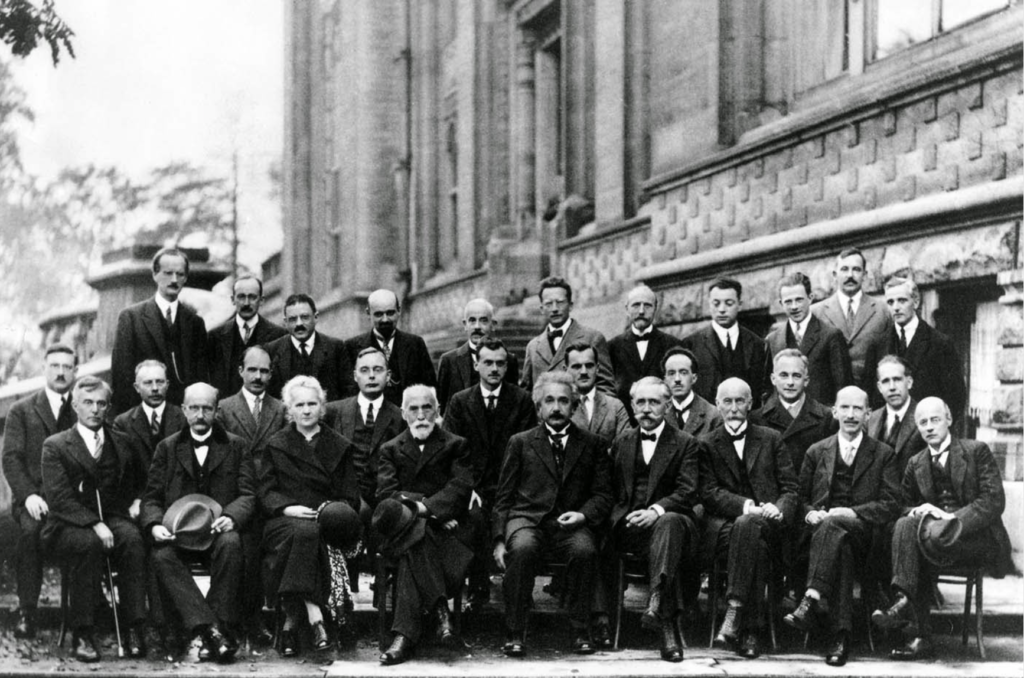
Most people who enter the physical sciences were inspired by the icons of science like Einstein, Feynman, and more recently, Gates and Musk. Young people who excel in academic subjects like mathematics are naturally drawn into the physical sciences where they can succeed. Teachers of these subjects, recognizing children with special proclivities, often encourage them and, where available, enrol them in programs for the gifted.
As these students enter undergraduate programs specializing in the physical sciences, they begin to discover the brilliant achievements of the icons who advanced the frontiers of human knowledge. Many formulate their lifetime goals hoping to match the achievements of these icons the way young golfers attempt to match the achievements of Jack Nicklaus and Tiger Woods.
Upon entering graduate school, these aspiring scientists begin to discover that there are other highly intelligent people who are striving toward similar goals. The normal “culling of the herd” results from a general recognition that achieving the Holy Grail of science involves total dedication, endless work, substantial sacrifices and no guarantee of success or even employment. Consequently, a small fraction of the original herd survives to conduct research at the frontiers of science.
The competition for “top dog” status is as intense in academia as it is in sports. Theoretical physicists, computer scientists and mathematicians have often engaged in bitter disputes about who was the discoverer of a new concept, theorem or scientific insight. Although there were some scientists who were more interested in exploring ideas rather than acquiring fame, the majority of the scientific community behaves much the same as those in other domains. While they may admire the icons, they also use them as benchmarks of brilliance that they seek to match or surpass.
However, as these aspiring scientists become more experienced, they come to realize that many of the iconic discoveries came at opportune times in areas that had immediate popularity. Einstein’s theories of relativity were, indeed, a monumental intellectual achievement that changed the paradigms of physics. However, Gödel’s incompleteness theorems a few short years later, changed the paradigms of mathematics, but almost no one has heard of Gödel, because his arcane result lies outside the interest of the general population.
Icons in science and sports serve as great motivators for young people as they formulate their goals. What begins as “hero worship” evolves into deep respect and becomes part of how we define ourselves and relate to other humans in our search for meaning.