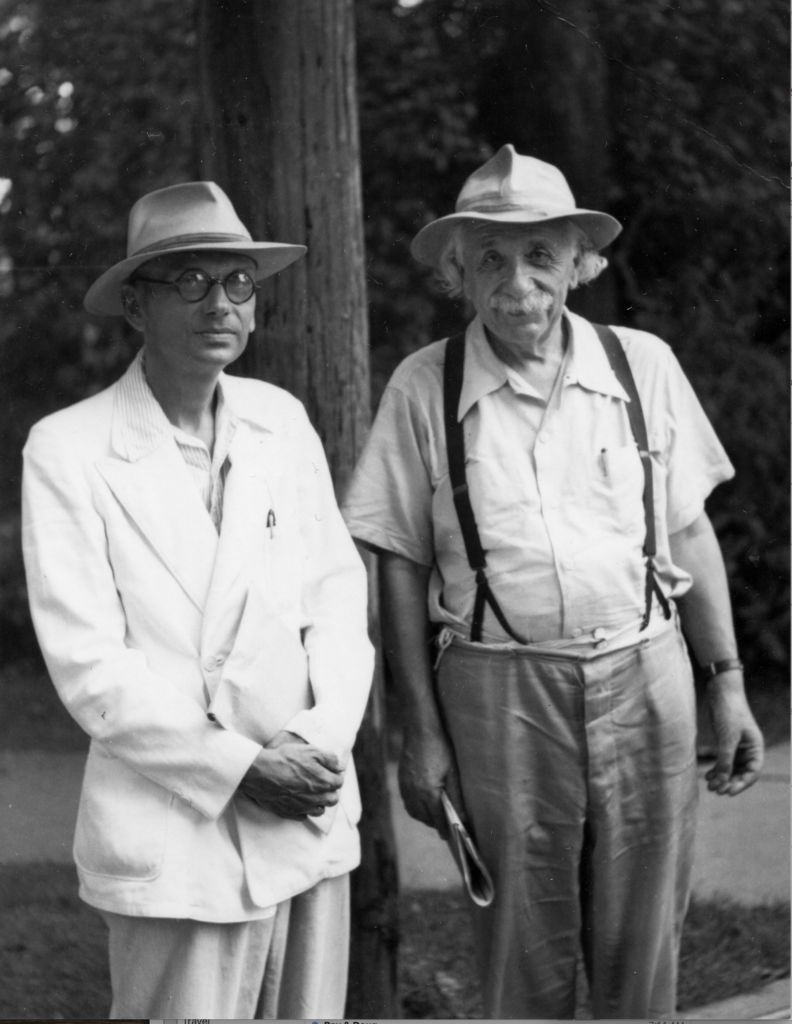
Some of the most creative and groundbreaking discoveries in mathematics and physics have emerged during the pursuit of a Ph.D. It is at that time that our fluid intelligence reaches its maximum power and the mind is not yet wedded to prevailing beliefs. Perhaps the most famous occurrence of brilliance during the pursuit of a Ph.D. was that of Albert Einstein who, within a few months of receiving his Ph.D., published papers that radically changed existing paradigms in physics.
Einstein
In 1905, while still toiling as a clerk in the Patent Office, Einstein was awarded a doctorate by the Zurich Physics Institute for his 21-page dissertation, A New Definition of Molecular Dimensions. Though the examining committee had been divided on whether it was “physics” or “mathematics”, a final judgment asserted, “[despite] crudeness in style and slips of the pen in the formulas which can and must be overlooked, …, [the paper displays a] thorough mastery of mathematical methods.”
Achieving a Ph.D. in physics was a relatively minor accomplishment for Einstein in a year that has become known as his annus mirabilis (miracle year). On March 17, 1905, two weeks after receiving his Ph,D., Einstein submitted to the physics journal Annalen der Physik a paper explaining the photoelectric effect–a paper for which he would eventually receive a Nobel Prize.
Then, just two months later, he submitted to that same journal another opus magnum, this time on Brownian motion, explaining how colliding molecules produce the random motion observed when microscopic particles like pollen grains oscillate in water.
Despite the significance of these two papers, they would eventually be eclipsed in importance by a third containing a revolutionary insight captured in his Special Theory of Relativity–an insight that would revolutionize physics irrevocably by challenging Newton’s assumption that space and time are absolute. These three papers, any one of which would have earned Einstein a place among the greatest physicists of all time, appeared in the celebrated Volume 17 of Annalen der Physik in July 1905.
Kurt Gödel
In 1931, an Austrian mathematician, Kurt Gödel, at age 25 published his doctoral thesis, On Formally Undecidable Propositions of Principia Mathematica and Related Systems. In this epoch-making paper, Gödel enunciated a theorem and corollary that registered a magnitude ten on the seismometer of mathematical quakes. The programs of both the formalists and the logicists collapsed like giant skyscrapers whose foundations had crumbled under a tectonic shift. The impact of Gödel’s discovery on the mathematics community would eventually exceed the trauma felt two millennia earlier with the discovery of irrational numbers. Though it took many years for the mathematics community at large to appreciate what Gödel had achieved, those who were working in the foundations of mathematics soon recognized the far-reaching implications of his powerful theorem and corollary. The brilliant wunderkind, John von Neumann, who had published The Axiomatization of Set Theory in 1928, was one of the first to perceive the “truth and importance of Gödel’s work.” Others soon followed and the initial shock wave eventually dissipated into a universal acceptance that absolute certainty of anything may be an illusion.
In 1978, an article in The New York Times described Gödel’s Theorem as “the most significant mathematical truth of this century, incomprehensible to laymen, revolutionary for philosophers and logicians.” A symbol-free expression of this theorem and its corollary is given here.
Gödel’s Theorem (called Gödel’s First Theorem)
In any mathematical system complex enough to contain simple arithmetic, there exists an undecidable proposition–that is, a proposition that is not provable and whose negation is not provable.
Corollary (Gödel’s Second Theorem)
The consistency of any mathematical system complex enough to contain simple arithmetic, cannot be proved within the system.
Gödel’s theorem implies that whether we choose the axioms of Peano, Hilbert, or Russell, there will always be theorems that are true, but can neither be proved nor disproved using only those axioms and the rules of logic. In this sense, the system is incomplete. We can prove or disprove any particular theorem in the system by adding one or more axioms, but then the corollary asserts that we will not know whether or not our new set of axioms is consistent.
Theoretically, we could enter any set of axioms into a computer and program it to print out all the theorems that are logical consequences of those axioms. The printout could contain an unlimited number of theorems, but there would always be some true statements that could be expressed in this system, but which would not appear in the printout.
John Nash
In 1941, at age 13, John Nash attended Bluefield College where his prowess in problem solving ignited his passion for mathematics. In 1945, he won a scholarship in the George Westinghouse Competition and was accepted by the Carnegie Institute of Technology (now Carnegie-Mellon University). In 1948, at age 20, John Nash received a BA and an MA in mathematics and was accepted into the Ph.D. mathematics programs at Harvard, Princeton, Chicago and Michigan, but ultimately chose Princeton.
During his time at Princeton, John Nash often skipped lectures, preferring to develop the mathematics himself with minimal reference to books or other sources. Though such an approach would be a recipe for disaster for most people, it was a modus operandi that gave his work a special originality. In fact, a paper in Game Theory titled Non-cooperative Games written during the first year of his Ph.D. earned him a Ph.D in 1950 and won him a Noble Prize in economics 45 years later.
Nash’s thesis laid the foundation for what is now called the Nash Equilibrium, a concept that fundamentally reshaped economics, political science, evolutionary biology, and more. (A Nash Equilibrium occurs when each player in a game chooses a strategy that is optimal, given the strategies of the other players.) Nash studied non-cooperative games, whereby players make decisions independently, each seeking to maximize their own payoff. Unlike cooperative games, where players can form binding agreements, Nash’s model is based on the assumption that self-interested agents act individually. The life of John Nash was presented in the 2001 movie “A Beautiful Mind.”
All of these Ph.D. theses were exceptional because they changed dramatically the existing paradigms in their subject area, changing the direction and focus of future research. Einstein’s research on the photoelectric effect contributed to the development of quantum physics and his special theory of relativity led to the mass-energy equivalence expressed in his famous equation E = mc^2. Gödel’s theorems proved that the Hilbert plan to prove the completeness and consistency of mathematics from the set of axioms in Russell’s Principia is impossible. This result has far reaching implications today for analyzing the mathematical potential of AI. And Nash’s models on strategic interdependence in game theory revealed that in competitive environments, individuals or firms don’t need to cooperate or communicate to reach a stable outcome. His game-theory models spawned widespread research that led to applications in biology, finance and computer science.
Both Nash and Gödel eventually developed paranoia, though Einstein remained psychologically stable throughout his life. All three individuals launched their careers during their pursuit of a Ph.D. and dedicated the rest of their lives to reinventing their field of expertise.