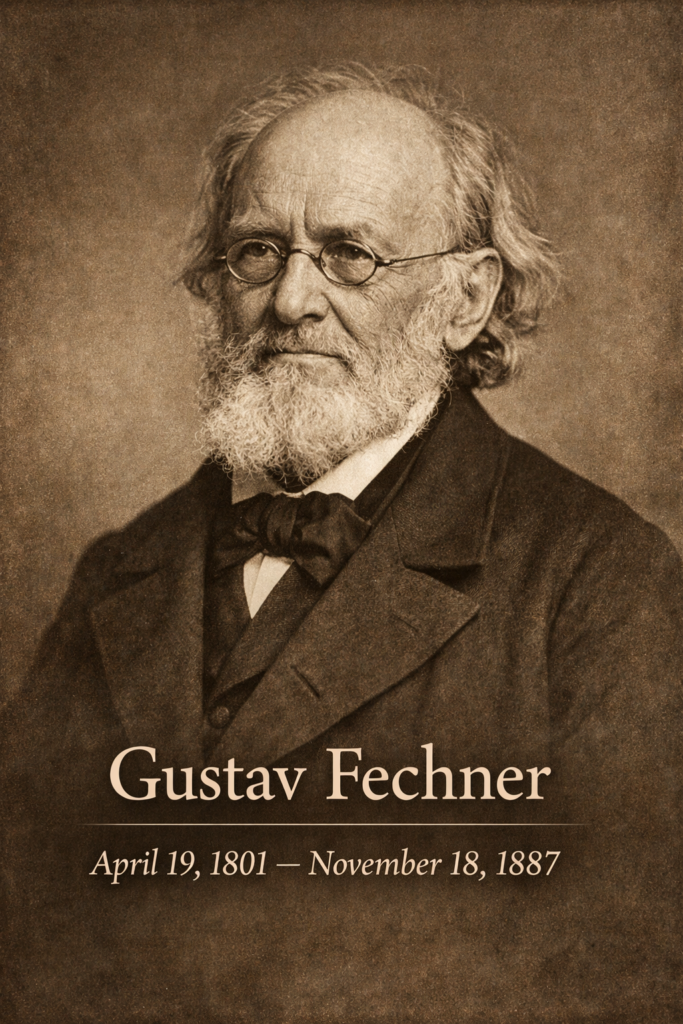
Our five senses are the only tools we have for perceiving the vast chaotic universe well enough to survive. Processing an infinite variety of stimuli through these senses and storing them as perceptions required significant compression and distortion of information. Gustav Fechner, a German physicist and experimental psychologist in the 1850’s explored the connection between the stimuli of external reality and our perceptions. For example, he observed that a ten-fold increase in the intensity of a sound is perceived as only a small difference in its audibility. A 100-fold increase in the sound is perceived as a doubling of that difference. He asserted, “In order that the intensity of a sensation may increase in arithmetical progression, the stimulus must increase in geometrical progression.” He also claimed that this relationship between the intensity of a stimulus and the resulting sensation, albeit approximate, is the same for sight as it is for sound.
He derived the following equation to express this relationship between the response R and the stimulus S in mathematical terms. (For a derivation of this formula, see Intelligence: Where we Were, Where we Are & Where we’re Going. pp. 399–400)
R = c log S + d where c and d are constants, and R is the measure of the response to a stimulus S. This equation is known as Fechner’s Law.
This law, originating in the field of physiology also found application in other fields such as, astronomy when the magnitudes of stars were deduced from the intensity and wavelengths of the light observed.
Why do our senses compress the stimuli of external reality into a smaller window of perception? As Joseph Heath observed, “Without this logarithmic compression, our ears, which are sensitive enough to hear a snake rustling in the grass, would be totally destroyed by the undiminished sound of a thunderclap.” Similarly, nature has compressed the spectrum of electromagnetic radiation so that our eyes can capture all the frequencies. So Fechner’s Law gives us a bridge from the world of our senses into the external world of “reality.”