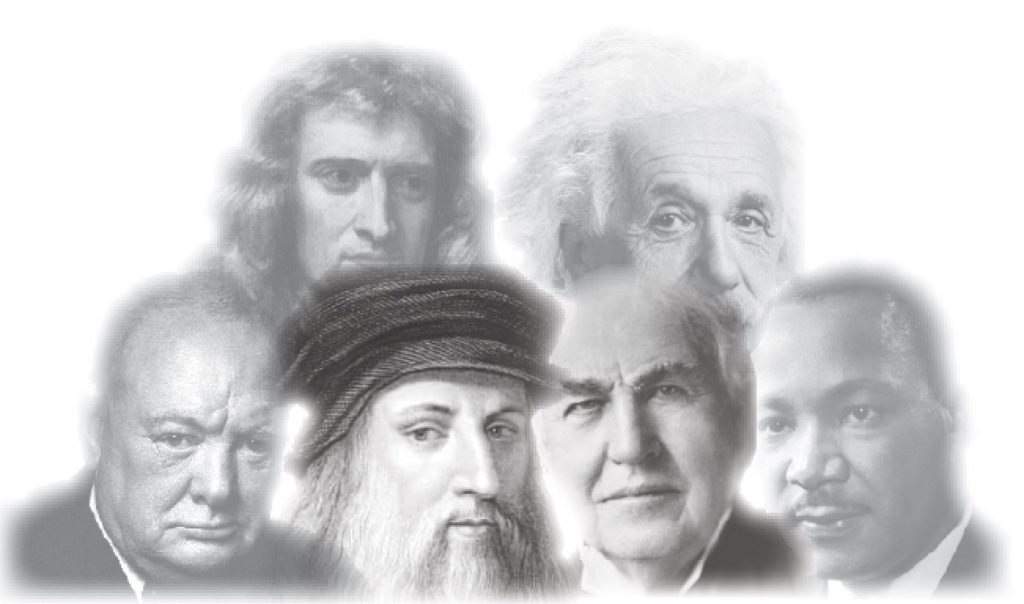
Learning about the struggles and triumphs of the great geniuses of the past can help young people harness rather than enhance their intelligence and potential. Many young people imagine that geniuses were recognized early, nurtured by their parents, sent to the best universities and then produced their masterpieces. However, this path to fame and glory was rarely the route taken by those who are hailed as quintessential geniuses. In fact, the biographies of the great geniuses reveal that genius-level performance does not arise from comfort or conformity, but rather from a combination of innate ability, and early conditions that force a mind to build its own internal structure—often in solitude, and often under adversity and strain.
Newton’s father died before Isaac was born and Isaac’s mother remarried and sent Isaac to live with her parents where Newton grew up without siblings or companions. He was bullied at school and spent most of his years in isolation, exploring on his own. He developed calculus and the law of universal gravitation while on leave from Cambridge during the plague of the early 1660’s.
Michelangelo’s mother died when he was 6 years old. His father was a nobleman and regarded drawing and art as skilled crafts rather than pursuits worthy of an intellectual. Consequently his father beat him when he expressed to wish to become an apprentice. Eventually, Michelangelo prevailed and was able to pursue his interests, but the struggle made him withdrawn and defensive.
Tesla, nearly died from Cholera during his late teens, then escaped to Austria to avoid the military draft in Croatia. While studying at the Polytechnic in Austria, he became addicted to gambling and had to leave the Polytechnic without a degree. He brought disgrace upon himself and his family. After employment in Paris, he emigrated to the United States where he worked for Thomas Edison who reneged on a promise to pay him for one of his inventions. Nikola Tesla had to work as a laborer for a year to survive during the Great Depression, and struggled financially through most of his life.
Mathematician, Évariste Galois, who founded group theory, was imprisoned for his political beliefs and died in a politically-orchestrated duel at age 20. John Nash, the subject of the movie A Beautiful Mind, suffered from schizophrenia through a major part of his life, and Elon Musk was browbeaten by his father and severely bullied by his classmates.
By reading the biographies of the greatest geniuses of the past and present, young people can learn that, although innate talent is a component of success, the greater part of turning that success into stellar achievement resides in the way a person deals with adversity. Thomas Edison once observed, “Most people quit just before they would have been successful.”