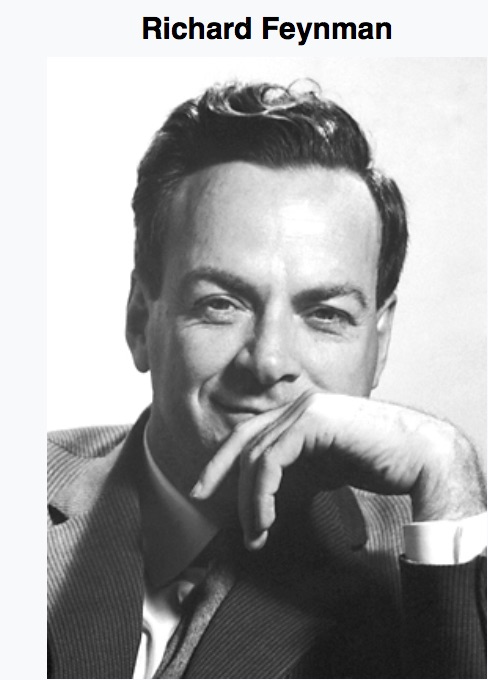
Throughout Richard Feynman’s formative years, his father, Melville, had impressed upon him the importance of rejecting authority and striving for authenticity. Melville worked in the garment industry selling uniforms—which he viewed as empty, formal symbols of artificial rank. Gleick, in his biography of Feynman observed:
Melville placed a high value on curiosity and a low value on outward appearances. He wanted Richard to mistrust jargon, and uniforms; as a salesman, he said, he saw the uniform empty. The pope himself was just a man in a uniform.
This mindset prompted Richard to approach problems in physics through exploration and intuition, without trusting the current consensus. Feynman’s brilliant contemporary, Freeman Dyson, initially held a mixed impression of his colleague. In an early letter to his parents, Dyson famously described Feynman as “half genius and half buffoon.” However, as the two spent more time collaborating, Dyson looked past the performer’s facade to witness Feynman’s deep, almost visceral instinct for physical reality, stating:
For a year I watched as Feynman perfected his way of describing nature with pictures and diagrams, until he had tied down the loose ends and removed the inconsistencies. …With astonishing speed he was able to calculate physical quantities that could be compared directly with experiment.
While other elite physicists in the realm of Quantum Electrodynmaics (QED), such as Julian Schwinger or Sin-Itiro Tomonaga, often looked at experimental results and crafted elegant, formal mathematical equations to match what was observed, Feynman felt that starting with the math could sometimes obscure the real physics. He believed the most honest approach to discovery was to visually imagine how the physical processes would unfold across space and time, and attempt to predict the empirical outcome. In this approach he resembled Einstein in his use of gedanken experiments. After encoding these physical processes into equations, he would use them to predict experimental results and compare them directly with reality. If the predictions failed, he discarded the theory without sentimentality and started anew. As Gleick observed:
Feynman continued to refuse to read the current literature, and he chided graduate students who would begin their work on a problem in the normal way by checking what had already been done. That way, he told them, they would give up chances to find something original.
It was this stubborn refusal to abandon the intuitive idea of the electron as a discrete particle moving through time that ultimately enabled him to develop the path-integral approach to QED and his iconic diagrams.
Feynman, like many of the iconic geniuses in mathematics and physics, combined the intense analytical mental focus of the prefrontal cortex with the subconscious search for eureka! moments, by following intense periods of focus with relaxed periods of reflection. One of the reflective moments that led to his ultimate development of the path integral formulation was his observation of the relative frequencies of the spin and wobble of a frisbee thrown in the Cornell cafeteria. The take-home message for people wishing to solve deep problems is to follow intense periods of work on a problem with periods of relaxation or rest, and let your subconscious search for the eureka! moment when insight hails its arrival.